Perfect Herb Butter Roasted Turkey with Garlic and Rosemary
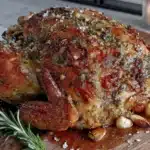
This herb butter roasted turkey is the recipe I turn to whenever I want to impress guests and feed a crowd without stress. It’s simple enough for a weeknight dinner but elegant enough for a holiday feast.
- Prep Time: 30 minutes
- Cook Time: 2 hours 30 minutes
- Total Time: 3 hours
- Yield: 12 servings 1x
- Category: Main Course
- Cuisine: American
Ingredients
Scale
- 1 whole turkey (12–14 pounds), thawed if frozen
- 1 cup (2 sticks) unsalted butter, softened to room temperature
- 6 cloves garlic, minced
- 3 tablespoons fresh rosemary, finely chopped
- 1 tablespoon fresh thyme leaves
- 1 tablespoon fresh sage, finely chopped
- 2 teaspoons kosher salt
- 1 teaspoon black pepper, freshly ground
- 1 lemon, halved
- 1 onion, quartered
- 4 sprigs fresh rosemary (for garnish and cavity)
- 2 cups low-sodium chicken or turkey broth
Instructions
- Prep the turkey. Remove the turkey from its packaging. Take out the giblets and neck from the cavity—save them for stock or gravy if you like, or discard them. Pat the turkey completely dry with paper towels, inside and out. This is important. Moisture is the enemy of crispy skin, so dry it thoroughly. Place the turkey on a rimmed baking sheet or in your roasting pan.
- Make the herb butter. In a small bowl, combine the softened butter, minced garlic, chopped rosemary, thyme, sage, kosher salt, and black pepper. Mix until everything is evenly distributed. Taste a tiny bit—it should be savory and fragrant, with a clear garlic and rosemary presence. If it tastes flat, add another pinch of salt.
- Loosen the skin. This is the step that makes the recipe. Using your fingers, gently loosen the skin over the turkey breast and thighs. Start at the neck cavity and work your fingers under the skin, being careful not to tear it. You want to create pockets between the skin and the meat. Go slowly—if the skin tears, it’s not the end of the world, but it’s better to keep it intact.
- Spread the butter. Take about two-thirds of the herb butter and spread it directly onto the meat under the loosened skin. Use your fingers to distribute it evenly over the breast and thighs. Don’t just blob it in one spot—spread it so every bite gets flavor. Then rub the remaining butter all over the outside of the turkey, including the legs and wings. Be generous. Every inch of skin should have some butter on it.
- Stuff the cavity. Place the lemon halves, quartered onion, and a few sprigs of fresh rosemary inside the turkey cavity. Don’t pack it tight—you want air to circulate. The aromatics will steam gently from the inside, keeping the meat moist and adding subtle flavor.
- Truss the turkey. Tie the legs together with kitchen twine. Tuck the wing tips under the body so they don’t burn. Trussing isn’t just for looks—it helps the turkey cook evenly and keeps the legs from drying out.
- Season and rest overnight (optional but recommended). Place the turkey on a rack in your roasting pan. If you have time, refrigerate it uncovered for 8 to 24 hours. This dries out the skin even more, which means it will be extra crispy when it roasts. If you’re short on time, just let it sit at room temperature for 30 minutes while the oven preheats.
- Preheat and prep the pan. Preheat your oven to 425°F. Pour the 2 cups of broth into the bottom of the roasting pan. This will catch drippings and prevent them from burning. Place the turkey on the rack over the broth.
- Roast at high heat. Roast the turkey at 425°F for 30 minutes. This high initial temperature helps the skin start crisping and gives it that beautiful golden color. Don’t open the oven during this time—let the heat do its work.
- Reduce heat and continue roasting. After 30 minutes, reduce the oven temperature to 350°F. Continue roasting, basting every 30 minutes with the pan juices. Use a basting brush or a large spoon to drizzle the juices over the turkey. This keeps the meat moist and adds layers of flavor.
- Check temperature. Start checking the internal temperature after about 2 hours of total roasting time. Insert your meat thermometer into the thickest part of the thigh, away from the bone. You’re looking for 165°F. The breast should be around 160°F—it will continue cooking as it rests. A 12–14 pound turkey typically takes 2 ½ to 3 hours total.
- Tent if needed. If the skin is browning too quickly, loosely tent the turkey with aluminum foil. Don’t seal it tight—you want air to circulate. I usually tent mine about 30 minutes before it’s done to prevent over-browning.
- Rest the turkey. Once the turkey reaches the right temperature, remove it from the oven. Transfer it to a cutting board or platter, tent it loosely with foil, and let it rest for at least 20 to 30 minutes. This is crucial. Resting allows the juices to redistribute throughout the meat. If you carve too soon, all those juices will run out onto the cutting board, leaving you with dry turkey.
- Make gravy (optional but encouraged). While the turkey rests, pour the pan drippings into a fat separator or a glass measuring cup. Skim off the fat. You can use the drippings as a base for gravy—just whisk in a little flour or cornstarch slurry over medium heat until thickened. Season with salt and pepper to taste.
- Carve and serve. Carve the turkey and arrange it on a platter. Garnish with fresh rosemary sprigs and maybe some orange slices for color. Serve immediately with the gravy on the side.
Notes
Don’t skip the overnight rest in the fridge for crispy skin. Use a thermometer, not the pop-up timer. Baste with pan juices, not butter. Let the turkey come to room temperature before roasting. Don’t open the oven too often.
Nutrition
- Serving Size: 4 ounces
- Calories: 190
- Sodium: 375
- Fat: 9
- Saturated Fat: 5
- Protein: 27
Keywords: herb butter roasted turkey, garlic rosemary turkey, Thanksgiving turkey, holiday turkey, roasted turkey, turkey recipe