I was at the grocery store last October, just minding my own business, when a kid in a tiny vampire costume sprinted past me and I caught the faint smell of a plastic pumpkin candy bucket — that weird, sweet, chemically scent that only exists in October. And suddenly I was seven years old at my Aunt Carol’s house, standing in her linoleum kitchen, watching her arrange carrot sticks into spider legs on a round platter. She wasn’t a fancy cook, my aunt. She burned toast on the regular. But every Halloween, she made this veggie tray that looked like a giant spider web, and I thought it was the most magical thing I’d ever seen. I mean, I was a kid who actually liked vegetables, so maybe I was weird. But still.
Aunt Carol passed away a few years ago, and nobody in the family makes her spider web veggie tray anymore. I tried to recreate it last year from memory, and honestly, the first attempt was a disaster. The “web” was lopsided, the dip was too runny, and the carrots kept sliding off the plate. But the second try? That was it. That was the one that made me close my eyes and feel like I was back in her kitchen, watching her hum along to the radio while she arranged black olives like little spider bodies. Maybe you’ve had that feeling — where a single bite of something simple brings back a whole person you miss.
This Easy Spider Web Veggie Tray is my tribute to Aunt Carol, and honestly, it’s become my go-to Halloween appetizer because it’s so ridiculously simple. You don’t need any special skills, just a round platter and some fresh veggies. It’s the kind of thing you can throw together in fifteen minutes while your kids are fighting over costume accessories. And the best part? It actually makes people eat vegetables at a party. That’s a Halloween miracle right there.
Why You’ll Love This Recipe
Let me tell you why this veggie tray has become my most-requested Halloween dish. I mean, I’ve brought it to four parties in the last two Octobers, and every single time, someone asks for the recipe. And every time, I have to explain that there really isn’t a recipe — it’s more of a arrangement. But people love it anyway.
- Quick & Easy : Seriously, this comes together in under 15 minutes. No cooking, no baking, no waiting for anything to cool. Just chop, arrange, and go. Perfect for those last-minute Halloween parties or when you realize the school costume parade is tomorrow and you signed up for snacks.
- Simple Ingredients : Everything you need is probably already in your fridge. Carrots, celery, bell peppers, broccoli — whatever you’ve got. And the dip? Just ranch or your favorite dressing. No fancy grocery trips required.
- Perfect for Halloween Parties : This isn’t just another veggie platter. The spider web design makes it feel festive without being over-the-top. It’s great for adult parties, kid-friendly gatherings, or even just a fun family snack before trick-or-treating.
- Crowd-Pleaser : You know how some appetizers sit there untouched? Not this one. I’ve watched kids who swear they hate vegetables go back for thirds. Something about the spider shape makes veggies feel like a treat instead of a chore.
- Unbelievably Delicious : Okay, it’s vegetables with dip. But the combination of crunchy fresh veggies with cool, creamy ranch is just perfect. And when they’re arranged in a spider web? Somehow they taste better. I swear it’s science.
What makes this different from every other veggie tray out there is the presentation. It’s not just a pile of vegetables on a plate — it’s a conversation starter. The spider web pattern makes people smile, and the little olive spiders are genuinely cute in a creepy way. Plus, you can customize it with whatever veggies your family actually eats. No more wasted broccoli that nobody touches.
This is the kind of appetizer that makes you look like a super-host without any actual effort. It’s Halloween-themed comfort food that happens to be healthy, and honestly, that’s the best kind of party food. You get to feel good about eating vegetables while also feeling festive. Win-win.
What Ingredients You Will Need
This recipe uses simple, fresh ingredients to create a spooky but healthy Halloween appetizer. The beauty of this dish is that you can really use whatever vegetables you have on hand, but here’s what I recommend for the classic spider web look.
For the Veggie Tray Base
- 1 large round platter or serving board (at least 12 inches in diameter — this is important for the web design)
- 1 cup ranch dressing or your favorite dip (I prefer Hidden Valley for that classic taste, but any thick, creamy dip works)
- 1 cup sour cream (optional, for making a thicker dip — I mix it half and half with ranch)
- Black food coloring (for making the web lines — or you can use balsamic glaze for a natural option)
For the Vegetables
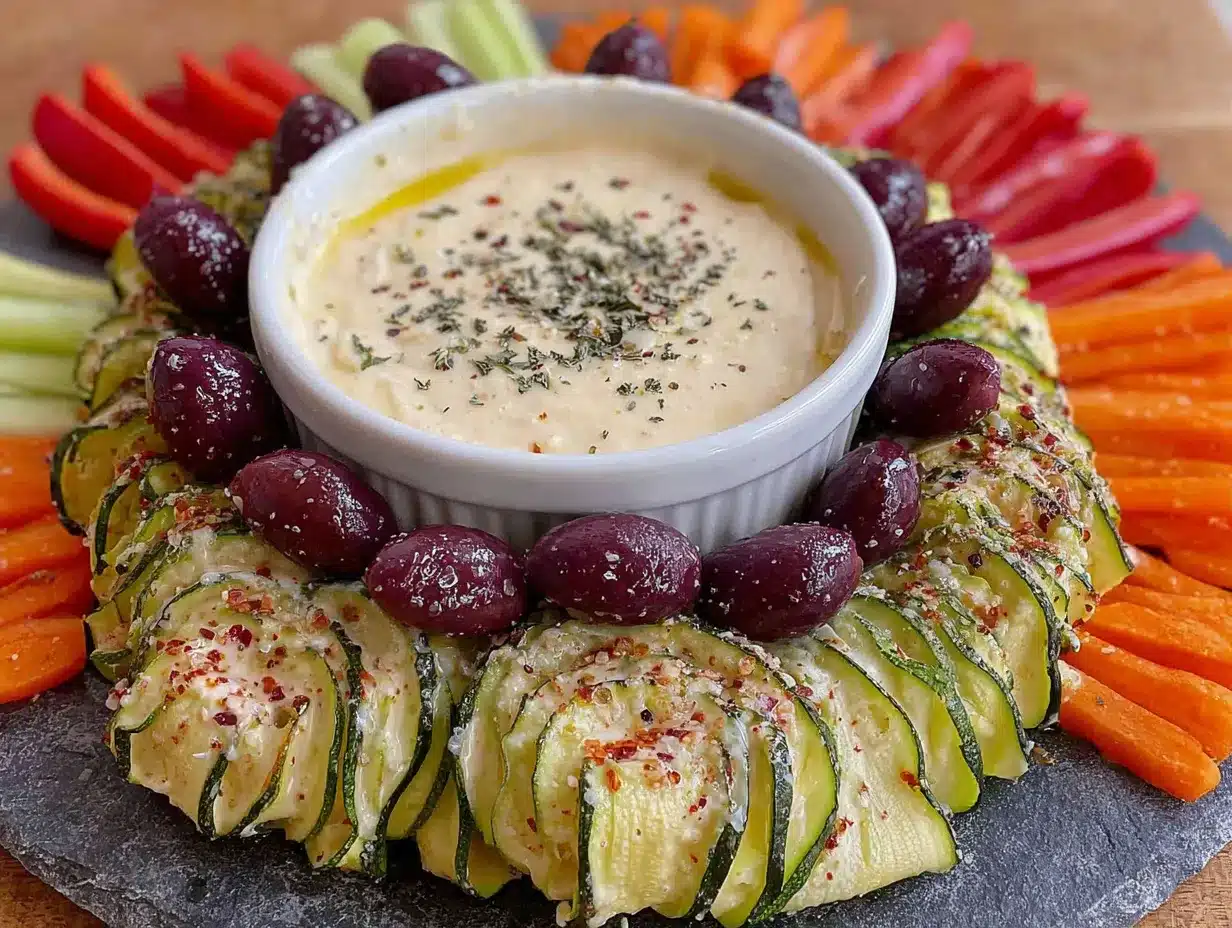
- 2 large carrots, peeled and cut into thin strips (about 3 inches long — these become the spider legs)
- 2 celery stalks, cut into 3-inch sticks (adds great crunch and green color)
- 1 red bell pepper, cut into strips (the red adds a nice pop of color against the green veggies)
- 1 yellow bell pepper, cut into strips (or orange, for more Halloween colors)
- 1 cup broccoli florets (small ones work best — they look like little trees in the web)
- 1 cup cauliflower florets (adds white contrast and texture)
- 1 cup cherry tomatoes (optional, but they add a nice burst of sweetness)
- 1/2 cup black olives, whole (these become your spider bodies — get the large ones if you can)
- 1/4 cup black olives, sliced (for making spider legs on the olive spiders)
For the Spider Web Design
- 1/4 cup balsamic glaze (this is my favorite trick — it’s thick enough to draw with and tastes amazing)
- Or 1/4 cup ranch mixed with black food coloring (if you want a creamier web design)
- Small piping bag or squeeze bottle (a ziplock bag with the corner snipped off works perfectly)
Ingredient Tips : For the best presentation, try to get vegetables that are all roughly the same size. I like to buy pre-cut veggie trays sometimes when I’m short on time, but honestly, cutting them yourself gives you more control over the sizes. For the olives, I recommend Mario brand pitted black olives — they’re firm and hold their shape well. And if you can’t find balsamic glaze, just simmer regular balsamic vinegar on the stove until it thickens. It takes about 10 minutes and works just as well.
Substitution Ideas : If you’re feeding picky eaters, swap out any veggies they don’t like. Cucumber sticks, sugar snap peas, or even bell pepper rings all work great. For a dairy-free version, use a vegan ranch or hummus as your dip base. The balsamic glaze is naturally vegan, so that’s an easy swap. And if you can’t find black olives, you can use large grapes or even small mozzarella balls for the spider bodies — just add little legs with chive pieces.
Equipment Needed
You don’t need much for this recipe, which is honestly my favorite part. Here’s what you’ll need:
- Large round platter or serving board : This is the most important piece. A round platter makes the spider web design so much easier. I use a 14-inch wooden cutting board I got from Target for like $12, and it works perfectly. If you don’t have a round platter, you can use a large dinner plate or even a pizza pan.
- Sharp knife and cutting board : For cutting your veggies into uniform strips. Nothing fancy needed.
- Small piping bag or squeeze bottle : For drawing the web design. I’ve used a ziplock bag with a tiny corner snipped off, and it works great. Just be careful not to cut too big of a hole.
- Small bowl : For your dip. You want something that fits in the center of your platter.
- Vegetable peeler : Optional, but helpful for getting those nice thin carrot strips.
Budget-Friendly Tip : Don’t run out and buy special equipment. I’ve made this on a paper plate before, and it still looked great. The key is just having a round surface. And if you don’t have a piping bag, seriously, a sandwich bag works. I learned that the hard way after spending $8 on piping bags I used once.
Preparation Method
Alright, let me walk you through how to make this spider web veggie tray. I’ve made this about a dozen times now, so I’ve figured out the best order of operations to make it look amazing without driving yourself crazy.
- Prep your veggies (about 10 minutes)
Start by washing and cutting all your vegetables. For the carrots, peel them first, then cut them into thin strips about 3 inches long and 1/4 inch wide. You want them thin enough to look like spider legs but thick enough that they won’t break. For the celery, cut them into similar-sized sticks. Cut your bell peppers into strips about the same size. Break your broccoli and cauliflower into small florets — I like them bite-sized so people can just grab and go. If you’re using cherry tomatoes, leave them whole. - Make your dip (2 minutes)
In your small bowl, mix the ranch dressing and sour cream together until smooth. If you’re using just ranch, that’s fine too. The sour cream just makes it a little thicker and creamier, which helps the web design hold better. Set this bowl aside for now. - Arrange the base layer (3 minutes)
Place your round platter on the counter. Put your small bowl of dip right in the center of the platter. Now, start arranging your vegetables around the bowl in a circular pattern. I like to start with the green veggies — broccoli and celery — to create a base ring. Then add your bell pepper strips and cauliflower. The key is to keep things even and circular. Don’t just pile them on — take a minute to arrange them nicely. - Create the spider web pattern (5 minutes)
This is the fun part. Take your balsamic glaze (or your black-colored ranch) and put it in your piping bag or squeeze bottle. Starting from the center bowl of dip, draw a line of glaze outward to the edge of the platter. Do this 8 times, like you’re drawing spokes on a wheel. Then, starting about 2 inches from the center, draw curved lines between the spokes to create the web pattern. Think of it like drawing a spider web — the lines should curve outward. I usually do 3-4 rings of web lines. Don’t worry if they’re not perfect — spider webs in nature aren’t perfect either. - Add the carrot spider legs (2 minutes)
Take your thin carrot strips and arrange them in groups of 8 around the edge of the platter, pointing inward toward the center. These look like spider legs creeping into the web. I usually place 4-5 groups of legs around the platter. Make sure the legs are evenly spaced. - Make the olive spiders (3 minutes)
This is the best part. Take your whole black olives — these are the spider bodies. For each spider, you need one whole olive and 8 small slices of olive for the legs. Place a whole olive on the web, then arrange 4 olive slices on each side to look like legs. I usually make 3-4 spiders scattered around the web. You can also use pretzel sticks for legs if you want a crunchier spider, but I like the all-olive look. - Fill in with remaining veggies (2 minutes)
Add any remaining vegetables around the edge of the platter to fill in empty spaces. Cherry tomatoes work great for this — they add a pop of red that looks like little spider eggs. Okay, that sounds gross, but it looks cute, I promise. - Final touches (1 minute)
Take a step back and look at your creation. Adjust any vegetables that look out of place. Make sure your web lines are visible. If you want, you can add a few extra carrot legs creeping over the edge of the platter for a dramatic effect.
Pro Tip : The first time I made this, I put the web lines on top of the vegetables, and they just slid off. You want to draw the web on the platter itself, then arrange the vegetables around the lines. Learned that one the hard way.
Cooking Tips & Techniques
Okay, let me share some things I’ve learned from making this veggie tray more times than I care to admit. Because honestly, my first few attempts were not pretty.
The Dip Consistency Matters : If your dip is too runny, it will just pool in the center and ruin your web design. I learned this when I used straight ranch and it spread everywhere. Mixing it half and half with sour cream gives you a thicker consistency that stays put. If you’re using hummus, make sure it’s a thick variety — some store-bought hummus is too loose.
Draw the Web First : I cannot stress this enough. Draw your spider web design on the empty platter before you add any vegetables. If you try to draw on top of the veggies, the lines will just slide off and make a mess. I found this out when I had to start over twice at a Halloween party. Not my finest moment.
Use Balsamic Glaze for the Win : Balsamic glaze is honestly the secret weapon here. It’s thick enough to draw clean lines, it tastes amazing with vegetables, and it dries slightly so it doesn’t smear. Plus, it’s naturally black, so you don’t need food coloring. If you can’t find it at the store, just simmer 1 cup of balsamic vinegar until it reduces by half. Let it cool before using.
Keep Veggies Dry : Wet vegetables will make your web lines run. After washing your veggies, pat them dry with a paper towel before arranging them. I forgot to do this once and my beautiful web turned into a black puddle. So disappointing.
Make Ahead Strategy : You can prep all your vegetables the day before and store them in separate bags in the fridge. Then just assemble everything 15 minutes before your party. The dip can be made ahead too. Just don’t draw the web until right before serving, or it might dry out and crack.
Variations & Adaptations
One of the best things about this recipe is how customizable it is. Here are some of my favorite variations I’ve tried over the years.
Dip Variations : While ranch is the classic, I’ve made this with hummus, spinach artichoke dip, and even guacamole. The key is making sure the dip is thick enough to hold the web design. For a healthier option, try Greek yogurt mixed with ranch seasoning. For a spicy version, mix sriracha into your ranch.
Vegetable Variations : Not a fan of broccoli? Swap it out. I’ve made this with cucumber rounds, sugar snap peas, jicama sticks, and even radish slices. The key is keeping the vegetables in similar sizes so the arrangement looks intentional. In the summer, I love using fresh cherry tomatoes and bell peppers from my garden.
Dietary Adaptations : For a vegan version, use a plant-based ranch or hummus and skip the sour cream. The balsamic glaze is already vegan. For gluten-free, this recipe is naturally gluten-free as long as you check your dip ingredients. For a low-carb option, focus on celery, cucumber, and bell peppers, and use a high-fat dip like ranch made with heavy cream.
Seasonal Twists : For a fall version, add sliced apples and pears to the veggie mix. For a Christmas version, use red and green bell peppers and arrange them in a wreath shape. I actually did that last year and it was a huge hit — just skip the spider web and draw a wreath design instead.
Personal Variation : My favorite version is what I call the “Monster Mash” — I add little mozzarella balls with olive slice eyes to make monster faces scattered around the web. My kids go absolutely crazy for it. It takes an extra five minutes but it’s so worth it for the giggles.
Serving & Storage Suggestions
This veggie tray is best served cold, right after you assemble it. The web lines look their best when they’re fresh, and the vegetables are at their crunchiest. If you’re serving it at a party, I recommend assembling it no more than an hour before guests arrive.
Serving Temperature : Keep the dip cold by placing the platter on a bed of ice or using a chilled serving board. If you’re serving outdoors, keep it in the shade — nobody wants warm ranch dressing. I learned this the hard way at an outdoor Halloween party when my dip turned into soup.
Presentation Ideas : For extra Halloween flair, add some fake spider webs around the platter (just make sure they don’t touch the food). You can also add plastic spiders on the board for decoration. I like to sprinkle a few edible glitter stars around the web for a magical touch — my niece calls it “spider fairy magic.”
Storage : If you have leftovers, remove the olive spiders first (they get weird in the fridge) and store the vegetables and dip separately. The veggies will keep in an airtight container in the fridge for 2-3 days. The dip can be stored for up to a week. Don’t try to save the web design — it won’t look the same the next day.
Reheating : There’s no reheating needed for this dish, but if your vegetables start to look a little sad after being in the fridge, you can revive them by soaking them in ice water for 10 minutes. This works especially well for celery and carrots.
Flavor Development : Honestly, this is one of those dishes that’s best fresh. The vegetables stay crunchy and the dip stays cold. If you make it too far ahead, the vegetables can start to wilt and the web lines can smear. Trust me on this — I’ve tried to make it the night before and regretted it.
Nutritional Information & Benefits
This veggie tray is actually a pretty healthy Halloween option, which is rare for a holiday that’s all about candy. Here’s a rough estimate per serving (about 1 cup of vegetables with 2 tablespoons of dip):
- Calories : Approximately 120-150 calories per serving
- Protein : 3-4 grams
- Carbohydrates : 12-15 grams
- Fiber : 3-4 grams
- Fat : 8-10 grams (mostly from the dip)
- Vitamin A : High (from carrots and bell peppers)
- Vitamin C : High (from bell peppers and broccoli)
Health Benefits : This appetizer is packed with vitamins and antioxidants. Carrots are great for eye health, bell peppers are loaded with vitamin C, and broccoli is a powerhouse of fiber and nutrients. The dip adds some healthy fats (if you use a good quality ranch) that help your body absorb the fat-soluble vitamins from the vegetables.
Dietary Considerations : This recipe is naturally gluten-free and can be made vegan by using plant-based dip. It’s also low in sugar and can be part of a low-carb diet if you focus on the lower-carb vegetables like celery and cucumber. The main allergen concern is dairy in the ranch dressing, but there are plenty of dairy-free alternatives available.
My Wellness Perspective : I love that this appetizer lets people indulge in Halloween fun without completely derailing their healthy habits. It’s a great way to get kids to eat vegetables, and honestly, I feel better about serving this alongside the candy. Balance, right?
Conclusion
This Easy Spider Web Veggie Tray has become such a beloved part of my Halloween traditions, and I hope it becomes one of yours too. It’s simple, it’s fun, and it actually gets people to eat their vegetables at a party where candy is the main attraction. I mean, that’s practically a superpower.
What I love most about this recipe is how it brings people together. Every time I make it, I think about Aunt Carol and her lopsided veggie trays, and I smile. Food has a way of doing that — connecting us to people and memories we don’t want to forget. And honestly, this little spider web platter is my way of keeping her Halloween spirit alive.
Don’t be afraid to make this your own. Use whatever vegetables your family loves, experiment with different dips, and have fun with the spider design. The first time might not be perfect — mine certainly wasn’t — but that’s okay. It’s about the joy of creating something festive and sharing it with the people you care about.
So go ahead, grab a round platter and some veggies, and make your own spider web. And when your guests start asking where you got the recipe, send them my way. I’d love to hear about your creations — share your photos and variations in the comments below. Happy Halloween, friends!
Frequently Asked Questions
Can I make this veggie tray the night before?
I don’t recommend assembling it the night before because the vegetables can wilt and the web design can smear. However, you can prep all your vegetables and make your dip the day before, then assemble everything about 30 minutes before serving. That’s my go-to strategy for party prep.
What can I use instead of balsamic glaze for the web?
You can mix ranch dressing with black food coloring for a creamy web, or use a thick balsamic reduction. Some people use black sesame paste thinned with a little water, or even black bean paste. The key is making sure it’s thick enough to draw clean lines that won’t run.
How do I keep the vegetables from sliding off the platter?
Make sure your platter is completely dry before you start arranging. You can also put a thin layer of dip on the bottom of the platter to help the vegetables stick — just don’t use so much that it shows. I’ve also used a slightly textured cutting board that gives the veggies something to grip.
What other designs can I make instead of a spider web?
You can arrange the vegetables in a pumpkin shape using orange bell peppers, or make a ghost shape with cauliflower and cream cheese dip. For a bat design, use black olives and bell pepper wings. The possibilities are endless — I’ve even done a Frankenstein face using green bell peppers and olive features.
How long will this veggie tray last at a party?
It’s best within the first 2 hours of assembly, especially if you’re serving it at room temperature. If you’re keeping it on ice, it can last up to 4 hours. After that, the vegetables start to wilt and the dip can separate. I usually make a fresh batch for longer parties — it only takes 15 minutes anyway!
Pin This Recipe!
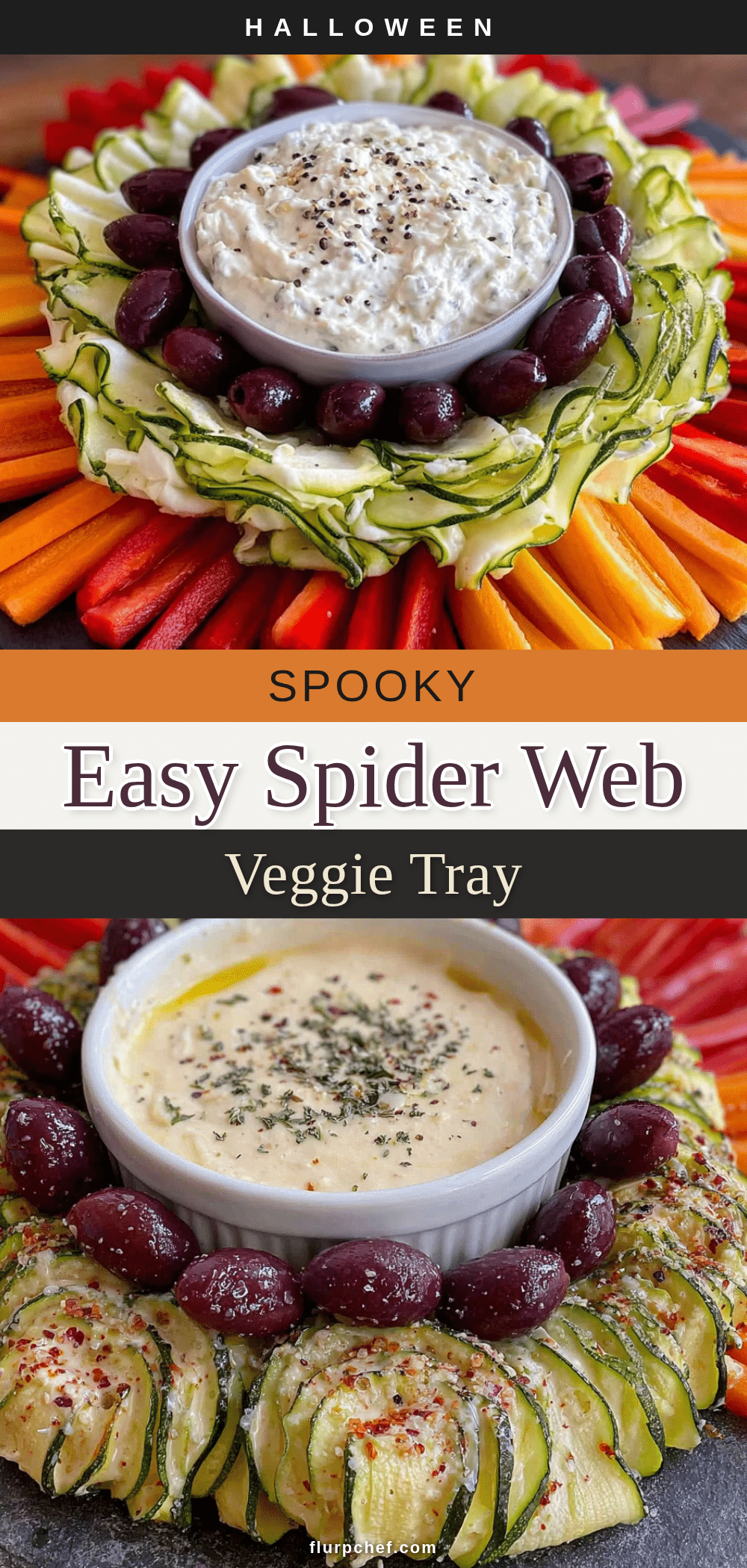
Easy Spider Web Veggie Tray – Best Halloween Appetizer
A fun and festive Halloween appetizer featuring fresh vegetables arranged in a spider web pattern with a creamy dip and olive spiders. Quick to assemble and perfect for parties.
- Prep Time: 15 minutes
- Cook Time: 0 minutes
- Total Time: 15 minutes
- Yield: 8 servings 1x
- Category: Appetizer
- Cuisine: American
Ingredients
- 1 large round platter or serving board (at least 12 inches in diameter)
- 1 cup ranch dressing or your favorite dip
- 1 cup sour cream (optional, for thicker dip)
- Black food coloring (or balsamic glaze for natural option)
- 2 large carrots, peeled and cut into thin strips (about 3 inches long)
- 2 celery stalks, cut into 3-inch sticks
- 1 red bell pepper, cut into strips
- 1 yellow bell pepper, cut into strips
- 1 cup broccoli florets
- 1 cup cauliflower florets
- 1 cup cherry tomatoes (optional)
- 1/2 cup whole black olives
- 1/4 cup sliced black olives
- 1/4 cup balsamic glaze (or ranch mixed with black food coloring)
- Small piping bag or squeeze bottle (or ziplock bag with corner snipped)
Instructions
- Prep your veggies: Wash and cut all vegetables. Peel carrots and cut into thin strips about 3 inches long and 1/4 inch wide. Cut celery into similar-sized sticks. Cut bell peppers into strips. Break broccoli and cauliflower into small florets. Leave cherry tomatoes whole if using.
- Make your dip: In a small bowl, mix ranch dressing and sour cream together until smooth. Set aside.
- Arrange the base layer: Place your round platter on the counter. Put the small bowl of dip in the center. Arrange vegetables around the bowl in a circular pattern, starting with green veggies (broccoli, celery), then bell peppers and cauliflower.
- Create the spider web pattern: Put balsamic glaze (or black-colored ranch) in a piping bag or squeeze bottle. Starting from the center bowl, draw a line of glaze outward to the edge of the platter. Repeat 8 times to create spokes. Then draw curved lines between the spokes, starting about 2 inches from the center, to create the web pattern. Do 3-4 rings of web lines.
- Add the carrot spider legs: Arrange thin carrot strips in groups of 8 around the edge of the platter, pointing inward toward the center. Place 4-5 groups of legs evenly spaced.
- Make the olive spiders: For each spider, use one whole olive for the body and 8 small olive slices for legs. Place a whole olive on the web, then arrange 4 olive slices on each side to look like legs. Make 3-4 spiders scattered around the web.
- Fill in with remaining veggies: Add any remaining vegetables around the edge of the platter to fill empty spaces. Cherry tomatoes work great.
- Final touches: Step back and adjust any vegetables. Make sure web lines are visible. Optionally add extra carrot legs creeping over the edge of the platter for dramatic effect.
Notes
Draw the web design on the empty platter before adding vegetables to prevent smearing. Keep vegetables dry to avoid runny web lines. For best results, assemble no more than an hour before serving. Balsamic glaze can be made by simmering 1 cup balsamic vinegar until reduced by half, then cooling.
Nutrition
- Serving Size: 1 cup vegetables wit
- Calories: 120150
- Sugar: 57
- Sodium: 300400
- Fat: 810
- Saturated Fat: 23
- Carbohydrates: 1215
- Fiber: 34
- Protein: 34
Keywords: Halloween appetizer, spider web veggie tray, vegetable platter, Halloween party food, easy appetizer, healthy Halloween snack


