There used to be a tiny Vietnamese sandwich shop on a side street in Portland called Lê’s that made the most incredible sriracha deviled eggs. I’m not kidding—they had them as a side option, tucked between the bánh mì and the spring rolls. When they closed in 2019, I actually stood outside the locked door for a solid minute feeling genuinely sad. After nine tries—nine batches of eggs, some so ugly I fed them to the neighbor’s chickens—I finally cracked it. And then I got a little carried away with the spider web design for Halloween, and suddenly this became the dish everyone asks me to bring to parties.
Honestly, I didn’t set out to make a “spider web” anything. I was just trying to recreate that spicy, creamy, slightly tangy filling from Lê’s. But the first time I drizzled sriracha in a spiral on top and dragged a toothpick through it, my friend Jen actually gasped. “That’s a spider web!” she yelled. And just like that, a Halloween classic was born. Now I make these for every gathering—Thanksgiving appetizer hour, summer cookouts, you name it. They disappear before the actual meal starts.
Maybe you’ve been there—you find a dish at some random spot that haunts you, and you spend way too much time trying to bring it back to life in your own kitchen. That’s exactly what happened here. And let me tell you, the payoff is worth every overcooked egg I had to toss along the way. These aren’t just pretty to look at. They’ve got that perfect balance of creamy yolk, spicy kick, and a little tang that makes people close their eyes after the first bite.
Why You’ll Love This Recipe
Let’s be real for a second. Deviled eggs are already the MVP of any party spread. But these sriracha spider web deviled eggs? They’re the ones people photograph before they eat. And then they eat three.
- Showstopper Presentation: The spider web design takes about 30 seconds per egg, but it looks like you spent hours. Your guests will think you’re a culinary artist.
- Bold, Balanced Flavor: The sriracha adds heat without overwhelming the creamy yolk filling. It’s spicy, tangy, and rich all at once.
- Perfect for Hosting: You can make the filling up to two days ahead. Just pipe and decorate before guests arrive. No last-minute stress.
- Crowd-Pleaser: I’ve brought these to potlucks, dinner parties, and Halloween bashes. They’re always the first empty platter.
- Customizable Heat: Adjust the sriracha to your crowd. Mild for the faint of heart, extra for the spice lovers.
What makes these different from every other deviled egg recipe out there? It’s the technique. I blend the yolks with mayo, rice vinegar (not white vinegar—trust me on this), and just enough sriracha to wake up your taste buds. Then that spider web drizzle on top? It’s not just decoration. That extra sriracha layer hits your tongue first, so every bite starts with a little surprise. My brother-in-law, who claims he “doesn’t like spicy food,” ate six of these last Thanksgiving before admitting they were “pretty good.”
This is the kind of recipe that makes you feel like a rockstar host without breaking a sweat. It’s comfort food with an edge, perfect for impressing guests or just treating yourself to something special.
What Ingredients You Will Need
This recipe uses simple, everyday ingredients to create something that tastes way more complicated than it is. Most of these are probably in your kitchen right now.
- 12 large eggs (room temperature eggs peel more easily—pull them out 15 minutes before boiling)
- 1/3 cup mayonnaise (I prefer Hellmann’s for its creamy texture, but any full-fat mayo works)
- 2 tablespoons sriracha sauce (Huy Fong is my go-to—the original rooster sauce. Adjust based on your heat tolerance)
- 1 teaspoon rice vinegar (unseasoned. This gives that subtle tang without being harsh like white vinegar)
- 1/2 teaspoon Dijon mustard (adds depth and a little sharpness. Grey Poupon is great)
- 1/4 teaspoon salt (fine sea salt dissolves better)
- 1/8 teaspoon white pepper (black pepper leaves dark specks—white pepper keeps it clean)
- Extra sriracha for the spider web design (about 1-2 teaspoons, depending on how many eggs you’re decorating)
- Optional garnishes: Black sesame seeds (look like tiny spider eggs), fresh chives (cut into 1-inch pieces for “legs”), or a sprinkle of smoked paprika
A few ingredient notes from someone who’s made about fifty batches of these: The rice vinegar is non-negotiable. I tried white vinegar once, and it was too sharp—it fought with the sriracha instead of complementing it. Also, please don’t use low-fat mayo. The filling needs that richness to balance the heat. If you’re dairy-free, you’re in luck—this recipe is naturally dairy-free. For a vegan version, use vegan mayo and skip the eggs entirely (though that’s a different recipe altogether).
I buy my eggs from a local farm when I can. The yolks are darker and richer, which makes the filling a gorgeous golden-orange color. But regular supermarket eggs work perfectly fine. Just make sure they’re not too fresh—eggs that are about a week old peel much easier after boiling.
Equipment Needed
You don’t need fancy equipment for these spider web sriracha deviled eggs, but a few tools make the process smoother.
- Large pot (big enough to hold 12 eggs in a single layer without crowding)
- Slotted spoon (for gently lowering eggs into boiling water and removing them)
- Bowl of ice water (for shocking the eggs after boiling—stops cooking and helps peeling)
- Mixing bowl (medium-sized, for mashing the yolks)
- Fork or potato masher (for breaking up the yolks. I prefer a fork for more control)
- Piping bag or zip-top bag (a zip-top bag with the corner snipped off works perfectly if you don’t have a piping bag)
- Toothpick or skewer (for creating the spider web design. A toothpick is ideal for precision)
- Sharp knife (a paring knife works best for cleanly halving the eggs)
- Serving platter (something with a slight lip to keep the eggs from sliding around)
I’ve made these with just a fork and a sandwich bag before, and they turned out great. The piping bag makes the filling look prettier, but it’s not essential. If you’re making these for a big party, consider getting a deviled egg carrier—it’s a game-changer for transport. I learned that the hard way after a car ride that turned my beautiful eggs into a scrambled mess.
Preparation Method
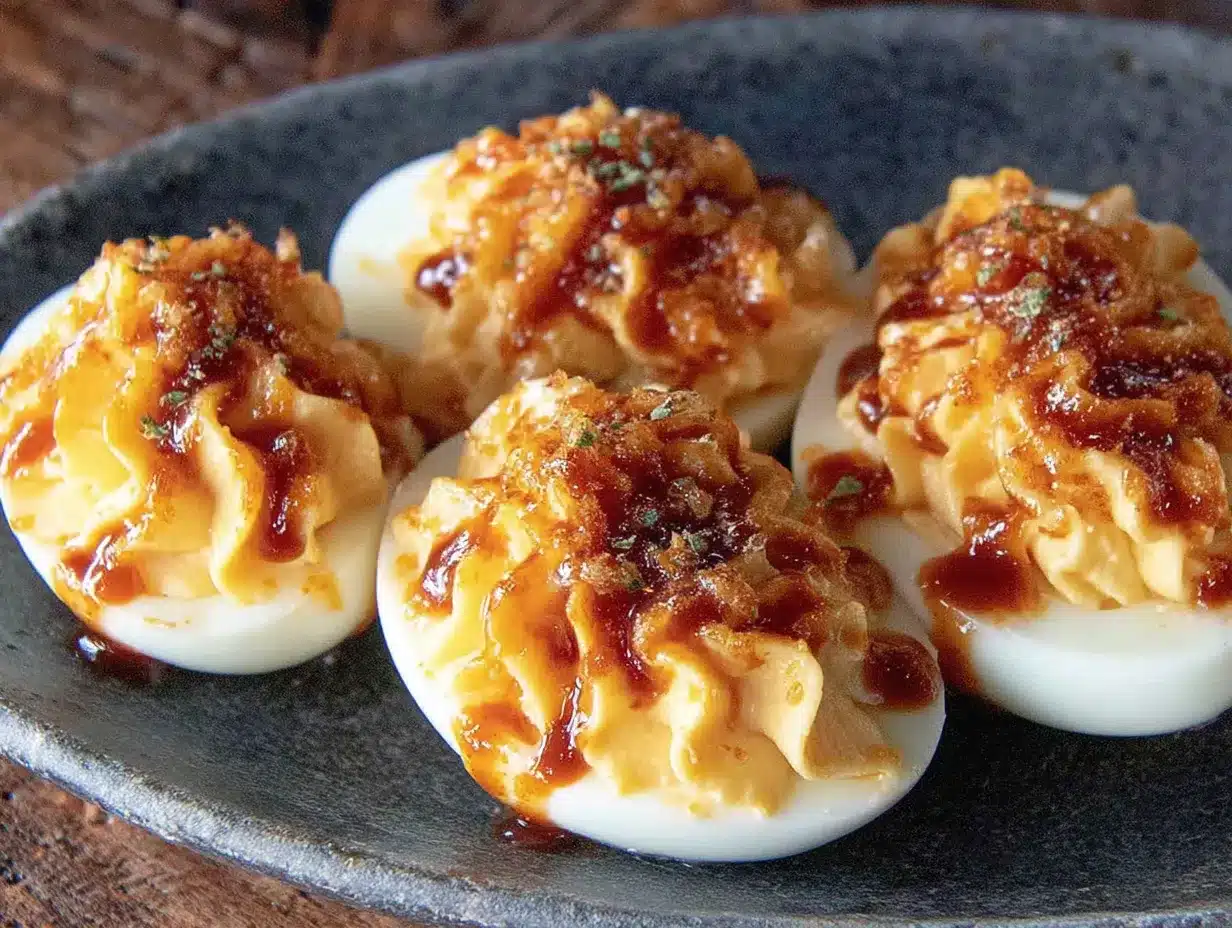
Let’s get into the nitty-gritty. I’ve broken this down into clear steps so you can nail it on the first try.
- Boil the eggs: Place your eggs in a large pot and cover them with cold water by about an inch. Bring the water to a rolling boil over high heat. Once it’s boiling, cover the pot, remove it from heat, and let it sit for exactly 9 minutes. Set a timer—seriously, don’t guess. While the eggs are sitting, prepare a bowl of ice water.
- Shock the eggs: After 9 minutes, use your slotted spoon to transfer the eggs to the ice water. Let them sit for at least 5 minutes. This stops the cooking process and makes peeling way easier. I’ve forgotten this step before, and peeling those hot eggs was a nightmare. Don’t be me.
- Peel the eggs: Gently crack the eggs all over, then roll them between your palms to loosen the shell. Start peeling from the wider end where the air pocket is. Running them under a little cold water helps remove stubborn shell bits. Pat the peeled eggs dry with a paper towel.
- Halve the eggs: Using a sharp knife, slice each egg lengthwise. Wipe the knife clean between cuts for neat halves. Carefully pop out the yolks into your mixing bowl. Arrange the egg white halves on your serving platter, cut-side up.
- Make the filling: Add the mayonnaise, 2 tablespoons sriracha, rice vinegar, Dijon mustard, salt, and white pepper to the bowl with the yolks. Mash everything together with a fork until smooth. I like to press the mixture through a fine-mesh sieve for an extra silky texture, but that’s optional. Taste the filling and adjust—more sriracha for heat, more salt if needed.
- Pipe the filling: Spoon the filling into your piping bag or zip-top bag. If using a zip-top bag, squeeze the filling into one corner and snip off about 1/4 inch of the tip. Pipe the filling into each egg white half, mounding it slightly. You should have enough filling for all 24 halves.
- Create the spider web design: This is the fun part. Drizzle a thin line of sriracha in a spiral pattern on top of each filled egg, starting from the center and working outward. You want a continuous spiral, not too thick. Then, take a toothpick and drag it from the center of the spiral outward through the sriracha lines, like drawing spokes on a wheel. Do this in 4-6 evenly spaced directions. The sriracha will pull into a web pattern. Wipe the toothpick clean between eggs for the best effect.
- Garnish and serve: If you’re using black sesame seeds or chive “legs,” add them now. The sesame seeds look like tiny spider eggs clustered in the center. Serve immediately, or refrigerate for up to 2 hours before serving. Don’t leave them out longer than that for food safety.
A quick sensory check: When you pipe the filling, it should be creamy and hold its shape—not runny. If it’s too loose, add another yolk (save one from another egg). The finished eggs should look plump and inviting, with the sriracha web standing out in bright red-orange against the pale yellow filling.
Cooking Tips & Techniques
After making these more times than I can count, I’ve collected some hard-won wisdom.
The perfect hard-boiled egg: Fresh eggs are actually harder to peel. If you can, buy your eggs a week before you plan to make these. The slight air pocket that develops over time makes peeling effortless. Also, adding a teaspoon of baking soda to the boiling water raises the pH and helps the shells slide off. Game changer.
Don’t overmix the filling: I learned this the hard way. Overmixing makes the filling gummy instead of creamy. Mash just until smooth and uniform. You want it light and fluffy, not paste-like.
Temperature matters: Cold filling is harder to pipe and doesn’t taste as good. Let your eggs come to room temperature before boiling, and let the filling sit for a few minutes after mixing before piping. The flavors meld better at room temperature.
The spider web trick: If the sriracha is too thick to drizzle nicely, thin it with a drop of water. You want it to flow easily but not be watery. Practice on a plate first if you’re nervous—I definitely ruined a few eggs my first time.
Timing for hosting: Here’s my strategy for parties. Boil and peel the eggs the day before. Make the filling and pipe it into the eggs up to 6 hours ahead. Add the spider web design right before serving. The sriracha web can bleed into the filling if it sits too long. I learned that one after making them three hours early and ending up with orange blobs instead of webs.
One more thing—if you’re making a double batch for a crowd, boil the eggs in two separate pots. Crowding the pot leads to uneven cooking. Trust me, I’ve had eggs that were perfect on one end and rubbery on the other.
Variations & Adaptations
This recipe is surprisingly flexible. Here are some ways to switch it up.
- Milder version: Cut the sriracha in the filling to 1 tablespoon and use a very thin drizzle for the web. The design still looks great without the intense heat. My mom loves this version.
- Extra spicy: Add 1/2 teaspoon of cayenne pepper to the filling and use a thicker sriracha drizzle. Top with thin slices of fresh jalapeño for maximum heat. My spice-loving friends request this version specifically.
- Smoky twist: Substitute 1 tablespoon of the mayonnaise with chipotle in adobo sauce (the liquid from the can). The smoky heat pairs beautifully with the sriracha. I tried this on a whim and it’s now my second-favorite version.
- Herbaceous addition: Mix 1 tablespoon of finely chopped fresh dill or cilantro into the filling. The freshness cuts through the richness. This is perfect for spring gatherings.
- Bacon love: Crumble crispy bacon on top before adding the spider web. Because everything is better with bacon. I made these for a Super Bowl party and they vanished in minutes.
- Avocado version: Replace half the mayonnaise with mashed ripe avocado. The filling becomes greener and creamier, with a subtle avocado flavor. This works best if you’re serving immediately, as avocado browns over time.
For dietary adaptations: This recipe is naturally gluten-free and low-carb. For a Whole30 version, use a compliant mayo and check your sriracha label (some brands add sugar). For a keto-friendly option, you’re already good—eggs and mayo are perfect for low-carb diets.
Serving & Storage Suggestions
These spider web sriracha deviled eggs are best served chilled or at room temperature. I prefer them slightly cool—straight from the fridge, but let them sit for 10 minutes first so they’re not ice-cold. The flavors are more pronounced at room temperature.
Presentation tips for hosting: Arrange the eggs on a dark-colored platter to make the spider web design pop. A black slate board or dark ceramic dish looks incredible. Add a few fake spider webs around the platter for Halloween parties—it’s cheesy but guests love it. For non-Halloween gatherings, arrange them in concentric circles and sprinkle with fresh chives.
What to serve alongside: These eggs pair beautifully with other finger foods. I often serve them alongside a charcuterie board, crispy bacon-wrapped jalapeño poppers, or a simple green salad. For drinks, a crisp white wine like Sauvignon Blanc or a cold beer cuts through the richness. Non-alcoholic? Sparkling water with lime is perfect.
Storage: Store leftover deviled eggs in an airtight container in the refrigerator for up to 2 days. Place them in a single layer with a paper towel on top to absorb excess moisture. Don’t freeze them—the texture becomes watery and sad.
Reheating: Honestly, you don’t reheat deviled eggs. They’re meant to be served cold or at room temperature. If you’ve stored them, just let them sit out for 15 minutes before serving to take the chill off.
Flavor development: The filling actually tastes better after a few hours in the fridge. The flavors meld and mellow. That’s why making the filling a day ahead works so well. Just don’t add the spider web design until serving time.
Nutritional Information & Benefits
Per serving (2 egg halves):
- Calories: 180
- Protein: 12g
- Fat: 14g
- Carbohydrates: 2g
- Fiber: 0g
- Sugar: 1g
These deviled eggs are surprisingly nutritious. Eggs are a complete protein source, meaning they contain all nine essential amino acids. They’re also rich in choline, which supports brain health, and vitamin D, which is hard to get from food. The sriracha contains capsaicin, which may boost metabolism and reduce inflammation. Rice vinegar adds a touch of probiotics if it’s unpasteurized.
This recipe is naturally low-carb and gluten-free, making it suitable for keto and paleo diets. It’s also high in healthy fats from the egg yolks and mayonnaise, which help keep you full and satisfied. If you’re watching sodium, use a low-sodium mayo and go easy on the salt—the sriracha already adds some.
I personally love that these eggs are a protein-packed appetizer that doesn’t weigh you down. At parties, I can enjoy a few without feeling sluggish, and they actually help stabilize my blood sugar before heavier foods.
Conclusion
These spider web sriracha deviled eggs are more than just a pretty party trick. They’re the result of a genuine obsession with recreating a dish I couldn’t get out of my head. And honestly, they’ve become something even better than the original. Every time I bring them somewhere, I watch people’s faces go from curious to delighted to absolutely hooked. That first bite—creamy, spicy, tangy—never gets old.
I hope you make these your own. Add more heat, skip the web design if you’re short on time, or pile on the bacon. The beauty of this recipe is that it’s forgiving and adaptable. And if you mess up the spider web on your first try? Don’t worry. I’ve been there. Just call it “abstract art” and watch them disappear anyway.
I’d love to hear how yours turn out. Drop a comment below and tell me about your spider web adventures. Did your guests freak out? Did you add your own twist? Share your photos, your questions, your victories. And if you’re looking for more crowd-pleasing appetizers, check out my bacon jalapeño popper dip or these crispy garlic chicken wings—they’re both guaranteed to empty your platter fast. Happy cooking, friends!
Frequently Asked Questions
Can I make these spider web deviled eggs ahead of time?
Yes! Boil and peel the eggs up to 2 days ahead. Make the filling and pipe it into the eggs up to 6 hours before serving. Add the spider web design right before serving for the best look.
How do I get perfectly peeled hard-boiled eggs every time?
Use eggs that are at least a week old. Add baking soda to the boiling water. Shock them in ice water immediately after cooking. Peel under running cold water for easiest removal.
Can I use a different hot sauce instead of sriracha?
Absolutely. Try sambal oelek for a similar flavor with more texture, or gochujang for a Korean-inspired twist. Just adjust the amount based on the heat level of your sauce.
How long do these deviled eggs last in the fridge?
Store them in an airtight container for up to 2 days. Place a paper towel on top to absorb moisture. Don’t freeze them—the texture will be ruined.
Can I make these dairy-free or vegan?
This recipe is naturally dairy-free. For a vegan version, use vegan mayo and substitute the egg whites with halved boiled potatoes or tofu. The filling can be made with mashed chickpeas and vegan mayo.
Pin This Recipe!
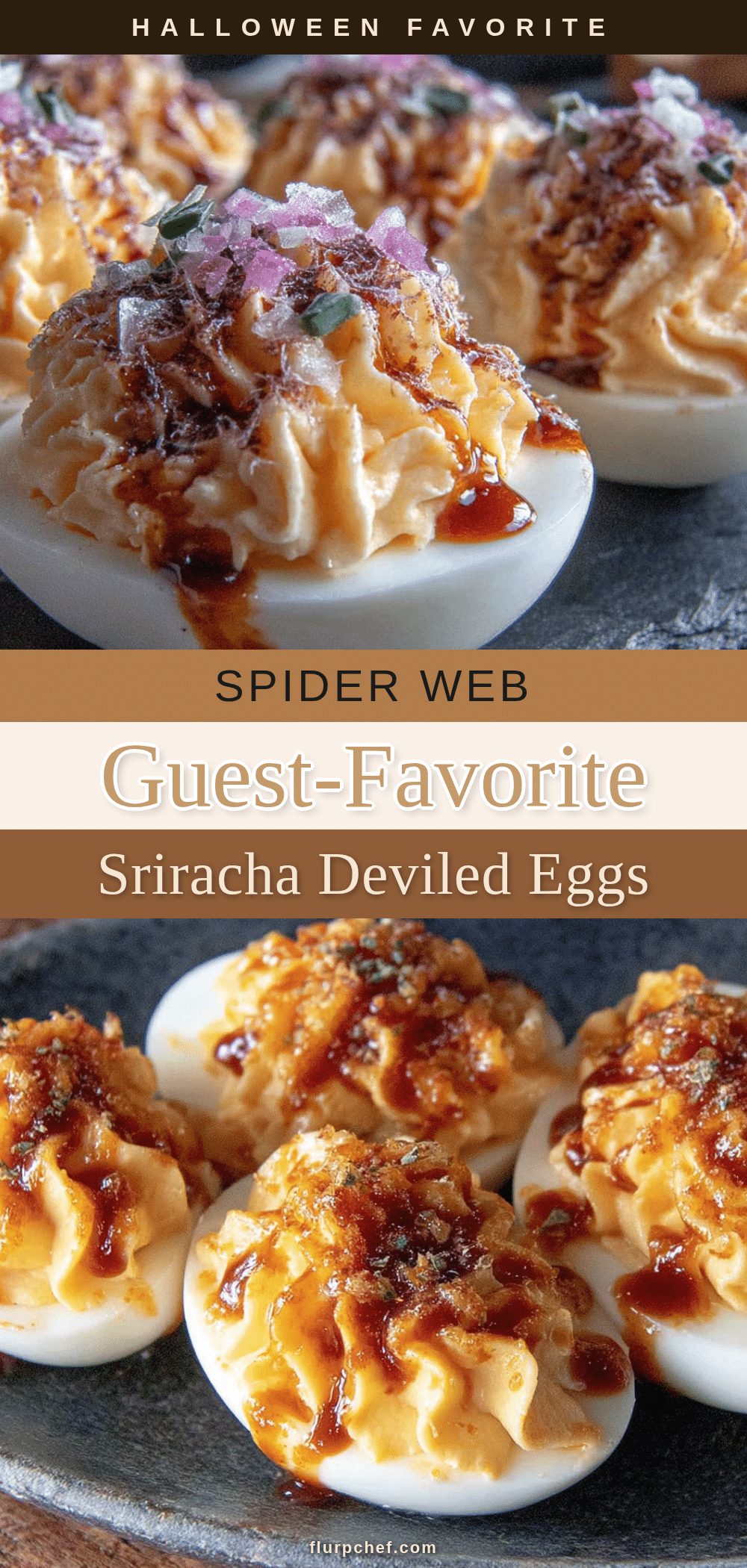
Best Spider Web Sriracha Deviled Eggs Recipe

These spider web sriracha deviled eggs are a showstopper appetizer with a creamy, spicy, and tangy filling topped with a dramatic sriracha web design. Perfect for Halloween, parties, or any gathering, they disappear before the main meal starts.
- Prep Time: 20 minutes
- Cook Time: 9 minutes
- Total Time: 45 minutes
- Yield: 24 deviled egg halves (12 servings of 2 halves each) 1x
- Category: Appetizer
- Cuisine: American
Ingredients
- 12 large eggs (room temperature)
- 1/3 cup mayonnaise (full-fat, e.g., Hellmann’s)
- 2 tablespoons sriracha sauce (e.g., Huy Fong)
- 1 teaspoon rice vinegar (unseasoned)
- 1/2 teaspoon Dijon mustard (e.g., Grey Poupon)
- 1/4 teaspoon fine sea salt
- 1/8 teaspoon white pepper
- 1–2 teaspoons extra sriracha (for spider web design)
- Optional garnishes: black sesame seeds, fresh chives (cut into 1-inch pieces), smoked paprika
Instructions
- Boil the eggs: Place eggs in a large pot, cover with cold water by 1 inch. Bring to a rolling boil over high heat. Cover, remove from heat, and let sit for exactly 9 minutes. Meanwhile, prepare a bowl of ice water.
- Shock the eggs: Transfer eggs to ice water using a slotted spoon. Let sit for at least 5 minutes to stop cooking and ease peeling.
- Peel the eggs: Gently crack eggs all over, roll between palms to loosen shell. Start peeling from the wider end. Run under cold water to remove stubborn bits. Pat dry.
- Halve the eggs: Slice each egg lengthwise with a sharp knife, wiping blade clean between cuts. Pop out yolks into a mixing bowl. Arrange egg white halves on a serving platter, cut-side up.
- Make the filling: Add mayonnaise, 2 tablespoons sriracha, rice vinegar, Dijon mustard, salt, and white pepper to the yolks. Mash with a fork until smooth. Taste and adjust seasoning.
- Pipe the filling: Spoon filling into a piping bag or zip-top bag. If using a zip-top bag, squeeze filling into one corner and snip off 1/4 inch of the tip. Pipe filling into each egg white half, mounding slightly.
- Create the spider web design: Drizzle a thin line of extra sriracha in a spiral on top of each filled egg, starting from center outward. Use a toothpick to drag from center outward through the sriracha lines in 4-6 evenly spaced directions to create a web pattern. Wipe toothpick clean between eggs.
- Garnish and serve: Add black sesame seeds or chive ‘legs’ if desired. Serve immediately or refrigerate for up to 2 hours before serving.
Notes
Use eggs that are at least a week old for easier peeling. Add 1 teaspoon baking soda to boiling water to help shells slide off. For best presentation, add the spider web design right before serving to prevent bleeding. The filling can be made up to 2 days ahead; pipe and decorate just before serving. For a milder version, reduce sriracha in filling to 1 tablespoon. For extra heat, add 1/2 teaspoon cayenne pepper to filling.
Nutrition
- Serving Size: 2 egg halves
- Calories: 180
- Sugar: 1
- Sodium: 320
- Fat: 14
- Saturated Fat: 3
- Carbohydrates: 2
- Protein: 12
Keywords: deviled eggs, sriracha, spider web, Halloween, appetizer, spicy, party food, gluten-free, low-carb


