It was 11:47 PM on a random Wednesday in March, and I had an overwhelming urge for birthday cake. Not just any birthday cake, but the kind with those little crunchy sprinkles that get all over your shirt and make you feel six years old again. The problem? It was almost midnight, I was in my pajamas, and there was no birthday in sight. I didn’t have a boxed mix, but I had flour, sugar, butter, and a half-empty jar of sprinkles from a kid’s party three months ago. The idea that arrived was simple: why wait for an actual birthday? Why not make the easiest, most reliable version of a classic birthday cake, right now, in the middle of the night, for absolutely no reason at all?
So there I was, barefoot on the cold kitchen tiles, measuring baking soda by the dim light of the stove hood. I forgot to soften the butter beforehand, which, honestly, is my signature move. I ended up using the microwave in ten-second bursts, praying I wouldn’t end up with melted butter soup. It worked out, somehow. The batter came together in one bowl—my favorite kind of mess—and when I pulled that single 8-inch layer out of the oven at 1 AM, the whole apartment smelled like a bakery. I ate a slice warm, with just a dusting of powdered sugar because the buttercream was a “future me” problem. Let me tell you, there is something magical about eating birthday cake on a Wednesday night with no one watching. It felt like a tiny act of rebellion. That moment is why I keep coming back to this recipe—it turns any ordinary evening into a small celebration, no party hat required. Maybe you’ve been there, staring into your pantry and wondering why we save the good stuff for special occasions.
Why You’ll Love This Recipe
This isn’t just another cake recipe. This is the one I’ve tested nine times to make sure it’s foolproof for busy people who don’t have time for fussy techniques. After years of developing recipes for my blog and working as a pastry assistant in a small bakery, I can tell you that most birthday cakes are overcomplicated. This one is different.
- Quick & Easy: From start to finish, this cake is on your table in under 90 minutes. That includes cooling time. The active work is only about 20 minutes of your evening.
- Simple Ingredients: You probably have everything in your kitchen right now. No buttermilk, no sour cream, no trips to a specialty store. Just butter, sugar, eggs, flour, and vanilla.
- Perfect for Any Occasion: Great for last-minute birthday parties, Tuesday night celebrations, or just because you want a slice of happiness after a long day.
- Crowd-Pleaser: The texture is soft and tender, the buttercream is sweet and creamy, and those sprinkles? They make everyone smile. Kids and adults fight over the last piece.
- Unbelievably Delicious: The secret is in the technique—creaming the butter and sugar for a full five minutes until it’s light and fluffy. This creates an airy crumb that stays moist for days.
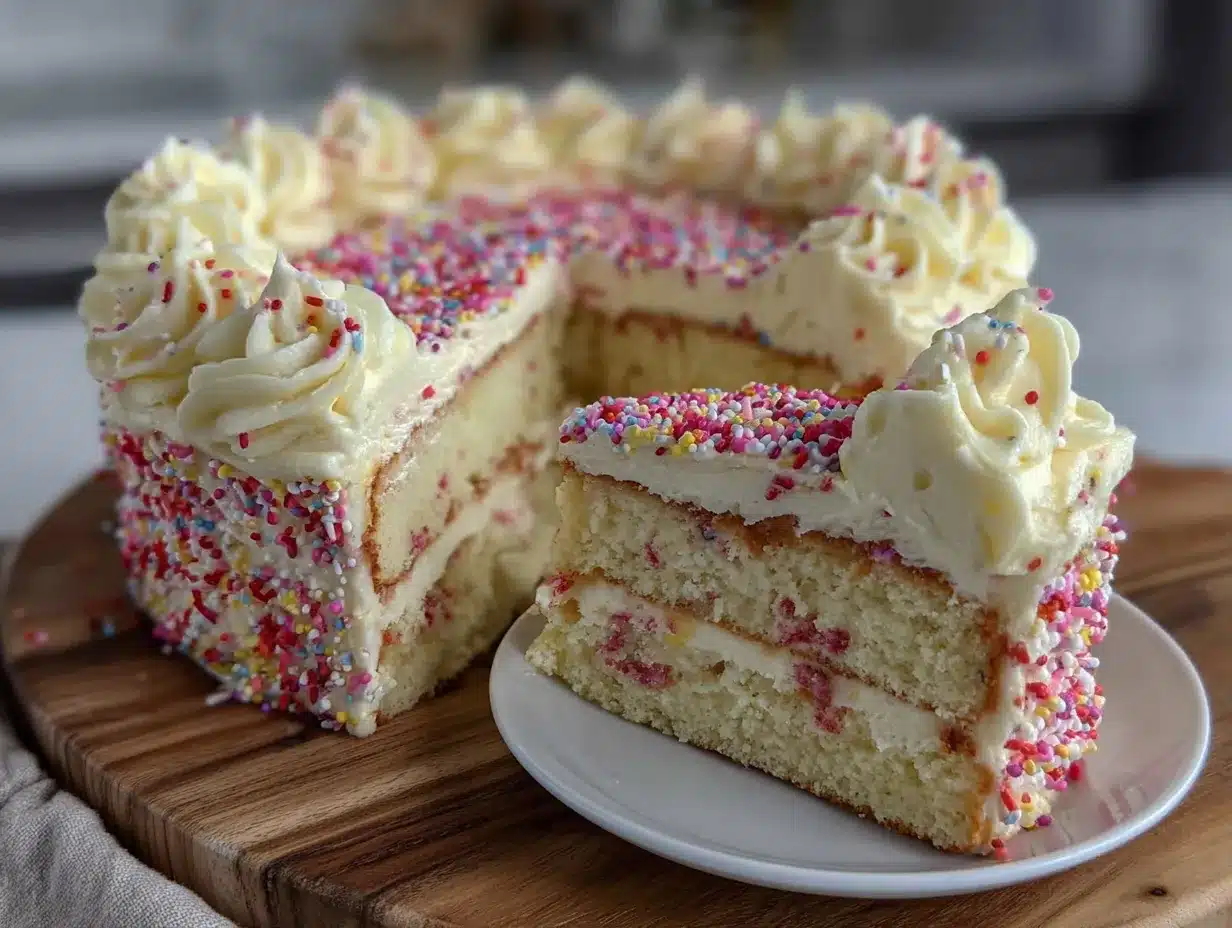
What makes this recipe stand out from every other vanilla cake is the sprinkle buttercream. Instead of just tossing sprinkles on top, we mix them right into the frosting. The result? Every single bite has that little crunch and pop of color. It’s not just a birthday cake—it’s a party in every mouthful. Honestly, this is the kind of cake that makes you close your eyes after the first bite. It’s comfort food reimagined: faster, simpler, but with the same soul-soothing satisfaction. Perfect for impressing your family on a school night without stressing yourself out.
What Ingredients You Will Need
This recipe uses simple, everyday ingredients to deliver a soft, tender cake and a creamy, colorful frosting. No fancy baking supplies required—just your basic pantry staples and a jar of sprinkles.
For the Cake
- 1 ½ cups (190g) all-purpose flour – Spoon and level it for accuracy. Too much flour makes a dry cake.
- 1 ½ teaspoons baking powder – This gives the cake its rise. Make sure it’s fresh (not expired).
- ¼ teaspoon salt – Balances the sweetness and enhances flavor.
- ½ cup (113g) unsalted butter, softened to room temperature – I use Kerrygold or Land O’Lakes for consistent results. If you forgot to soften it, cut it into small cubes and let it sit for 15 minutes.
- 1 cup (200g) granulated sugar – Regular white sugar works best for that classic birthday cake flavor.
- 2 large eggs, room temperature – Cold eggs can seize the batter. Place them in a bowl of warm water for 5 minutes if you’re in a hurry.
- 2 teaspoons vanilla extract – Pure vanilla, not imitation, for the best flavor. I prefer Nielsen-Massey.
- ½ cup (120ml) whole milk, room temperature – Whole milk gives a richer crumb, but 2% works in a pinch.
For the Sprinkle Buttercream
- 1 cup (226g) unsalted butter, softened – Yes, a full cup. This is a celebration, after all.
- 3 ½ cups (420g) powdered sugar – Sift it if it’s lumpy. Nobody wants a lump of sugar in their frosting.
- 2 tablespoons heavy cream or whole milk – Heavy cream makes it extra luxurious.
- 1 ½ teaspoons vanilla extract – Double the vanilla for that nostalgic bakery taste.
- ⅓ cup (60g) rainbow jimmies sprinkles – Not the round nonpareils! Jimmies are the long, rod-shaped sprinkles that don’t bleed their color into the frosting. Trust me on this one.
- Pinch of salt – Cuts the sweetness so it’s not cloying.
Equipment Needed
- Two 8-inch round cake pans – If you only have 9-inch pans, the layers will be thinner, so reduce baking time by 5 minutes. I’ve used both, and 8-inch gives you those nice tall layers.
- Electric hand mixer or stand mixer – You can do this by hand with a whisk, but your arm will get a workout. I’ve done it both ways, and the mixer is worth the cleanup.
- Mixing bowls – One large bowl for the cake batter, one medium bowl for the frosting.
- Rubber spatula – For scraping down the bowl and folding in sprinkles.
- Cooling rack – Essential for even cooling. If you don’t have one, use the wire rack from your oven.
- Offset spatula or butter knife – For spreading the frosting. A butter knife works fine; an offset spatula just looks fancier.
- Parchment paper – Cut circles for the bottom of the pans. This is non-negotiable for easy release.
- Kitchen scale (optional but helpful) – For accurate measurements. I use mine every time now after too many dry cakes.
Preparation Method
Step 1: Preheat and Prep the Pans (5 minutes)
Preheat your oven to 350°F (175°C). Grease two 8-inch round cake pans with butter or non-stick spray. Cut two circles of parchment paper to fit the bottoms, place them in the pans, and grease the parchment too. This extra step guarantees your cakes will come out clean every time. I learned this the hard way after spending 20 minutes picking cake out of a pan.
Step 2: Whisk the Dry Ingredients (2 minutes)
In a medium bowl, whisk together the flour, baking powder, and salt. Set this aside. Whisking aerates the flour and distributes the leavening agents evenly. No need to sift unless your flour is really lumpy.
Step 3: Cream the Butter and Sugar (5 minutes)
In a large mixing bowl, beat the softened butter and granulated sugar together on medium-high speed until light, fluffy, and pale in color. This should take a full 5 minutes. Don’t rush it. Scrape down the sides of the bowl halfway through. This step is where the magic happens—it creates tiny air pockets that make your cake tender and light. If you stop early, your cake will be dense and flat.
Step 4: Add the Eggs and Vanilla (2 minutes)
Add the eggs one at a time, beating well after each addition. Then add the vanilla extract and beat until combined. The batter might look slightly curdled at this point—that’s normal. Don’t panic. Just make sure each egg is fully incorporated before adding the next.
Step 5: Alternate the Dry and Wet Ingredients (3 minutes)
With the mixer on low speed, add one-third of the flour mixture to the butter mixture. Mix until just combined. Pour in half of the milk, mix briefly, then add another third of the flour. Follow with the remaining milk, then the last of the flour. Mix only until you no longer see streaks of flour. Overmixing at this stage develops gluten, which makes the cake tough. Use your spatula to give the batter a final fold from the bottom, just to catch any unmixed flour hiding there.
Step 6: Divide and Bake (25-30 minutes)
Divide the batter evenly between the two prepared pans. Use a kitchen scale for accuracy if you have one—each pan should have about 450g of batter. Smooth the tops with a spatula. Bake for 25-30 minutes, or until a toothpick inserted into the center comes out clean or with a few moist crumbs. The cakes should be golden brown and pulling away slightly from the edges of the pan. Let them cool in the pans for 10 minutes, then turn them out onto a cooling rack to cool completely. Do not frost a warm cake—your buttercream will melt into a puddle.
Step 7: Make the Sprinkle Buttercream (10 minutes)
While the cakes cool, make the frosting. In a large bowl, beat the softened butter on medium speed until smooth and creamy, about 2 minutes. Gradually add the powdered sugar, one cup at a time, beating on low speed to prevent a sugar cloud. Add the heavy cream, vanilla extract, and a pinch of salt. Increase the speed to medium-high and beat for 3-4 minutes until the frosting is light, fluffy, and spreadable. If it’s too thick, add another tablespoon of cream. If it’s too thin, add a bit more powdered sugar. Finally, fold in the sprinkles with a spatula. The batter will look like a rainbow explosion—this is exactly what you want.
Step 8: Assemble and Frost (15 minutes)
Place one cooled cake layer on your serving plate or cake stand. Spread about ½ cup of buttercream evenly on top. Place the second layer on top, upside down, so the flat bottom becomes the top of the cake. This gives you a perfectly level surface. Apply a thin layer of frosting all over the cake (this is called a crumb coat) and refrigerate for 15 minutes to set. Then apply the remaining frosting in a thick, generous layer. Go wild with it—this is birthday cake, not a museum piece. Top with extra sprinkles if you’re feeling festive.
Cooking Tips & Techniques
I’ve made this cake more times than I can count, and I’ve learned a few things the hard way. First, room temperature ingredients are not optional. Cold butter doesn’t cream properly, cold eggs can make the batter seize, and cold milk won’t emulsify. If you’re in a rush, microwave your milk for 15 seconds and place your eggs in a bowl of warm water for 5 minutes. Your butter should give slightly when you press it with your finger.
Another common mistake is overmixing the batter. I did this once while distracted by a phone call, and the cake came out dense and rubbery. Mix until the flour just disappears, then stop. A few small lumps are fine—they’ll bake out. Also, don’t open the oven door during the first 20 minutes of baking. The sudden temperature drop can cause your cake to sink in the middle.
For the buttercream, the biggest mistake is not beating it long enough. That 3-4 minute beat time at the end is what makes it light and fluffy instead of dense and greasy. If your frosting looks curdled or separated, don’t panic. It usually means your butter was too cold. Just keep beating—it will come together. I’ve had this happen at least three times, and it always smooths out eventually.
Timing is everything on a busy weeknight. I like to bake the cake layers the night before, wrap them tightly in plastic wrap once cool, and frost them the next day. The cake actually tastes better the next day because the flavors have time to meld. If you’re making this on the same day, start the frosting while the cakes are cooling to save time.
Variations & Adaptations
One of the best things about this recipe is how flexible it is. Here are a few ways I’ve adapted it over the years:
Chocolate Birthday Cake: Replace ¼ cup of the flour with ¼ cup of unsweetened cocoa powder. Add an extra tablespoon of milk to compensate for the dry cocoa. The result is a rich, chocolatey version that pairs beautifully with the sprinkle buttercream. My nephew requests this for every birthday.
Lemon Sprinkle Cake: Add the zest of one lemon to the sugar and rub it in with your fingers before creaming with the butter. Replace the vanilla in the cake with 1 teaspoon of lemon extract. For the frosting, add 1 tablespoon of lemon juice and reduce the milk by half. The bright citrus flavor cuts through the sweetness perfectly.
Gluten-Free Option: Use a 1:1 gluten-free baking flour blend that contains xanthan gum. I’ve tested this with Bob’s Red Mill 1-to-1 Baking Flour, and it works beautifully. The texture is slightly more delicate, so handle the layers gently. No one at the party will know the difference.
Dairy-Free Version: Substitute the butter with a high-quality vegan butter stick (not margarine from a tub). Use oat milk or almond milk in place of whole milk. For the frosting, use vegan butter and a dairy-free creamer. The flavor is still rich and the texture stays soft.
Cupcakes: This recipe makes about 18 standard cupcakes. Bake them at 350°F (175°C) for 18-20 minutes. The sprinkle buttercream pipes beautifully through a star tip for a bakery-style finish.
Serving & Storage Suggestions
This cake is best served at room temperature. If you’ve refrigerated it, let it sit on the counter for about 30 minutes before slicing. The buttercream softens and the cake crumb becomes tender again. For a truly decadent experience, serve each slice with a small scoop of vanilla ice cream or a dollop of whipped cream.
For storage, keep the cake in an airtight container at room temperature for up to 3 days. Yes, room temperature! Buttercream sets at room temperature, and the cake stays moist. Refrigeration actually dries out the cake and hardens the frosting. If your kitchen is very warm (above 75°F or 24°C), refrigerate it, but bring slices back to room temperature before serving.
This cake freezes beautifully. Wrap the unfrosted cake layers individually in plastic wrap, then in foil, and freeze for up to 3 months. Thaw at room temperature before frosting. You can also freeze the frosted cake whole. Place it in the freezer unwrapped for 1 hour to set the frosting, then wrap it tightly in plastic wrap and foil. Thaw in the refrigerator overnight. The flavors actually deepen after freezing—I’ve done this for parties and gotten compliments on “the best cake I’ve ever had.”
One note on the sprinkles: after a day or two, the sprinkles in the buttercream may start to bleed their color slightly, creating a pretty tie-dye effect. This is harmless and actually looks kind of cool. If you want to avoid it, wait to add the sprinkles until just before serving.
Nutritional Information & Benefits
Let’s be honest—this is a celebration cake, not a health food. But here’s the estimated nutritional breakdown per slice (based on 12 servings): approximately 450 calories, 24g fat, 58g carbohydrates, 4g protein, and 38g sugar. The butter provides a good source of vitamin A and healthy fats, while the eggs contribute protein and choline for brain health.
For those with dietary restrictions, this recipe can be made gluten-free or dairy-free using the substitutions mentioned above. It contains wheat, dairy, and eggs, so it’s not suitable for vegan diets as written. If you’re watching your sugar intake, you can reduce the sugar in the cake to ¾ cup without affecting the texture too much, but the frosting needs the full amount for structure.
My personal perspective? This cake is about joy, not nutrition. It’s the kind of treat you make for a birthday, a promotion, or a Tuesday that just needs a little brightness. One slice won’t derail your wellness goals, but it might make your day a whole lot better. Balance is everything.
Conclusion
This easy classic birthday cake with sprinkle buttercream is the recipe you’ll come back to again and again. It’s simple enough for a beginner baker but impressive enough for a party. The soft, tender crumb and the creamy, colorful frosting come together in under two hours, using ingredients you probably already have. I love this recipe because it reminds me that celebrations don’t have to be complicated. Sometimes the best moments are the ones we create on a random Wednesday night, with a whisk in one hand and a jar of sprinkles in the other.
I encourage you to make this your own. Add extra vanilla, swap the sprinkles for chocolate chips, or turn it into a layer cake with three tiers. The beauty of a classic recipe is that it’s a starting point, not a rulebook. When you make it, I’d love to hear how it turned out. Leave a comment below or tag me in your photos—there’s nothing that makes me happier than seeing this cake bring joy to your kitchen. Now go preheat that oven. Your birthday cake is waiting, no special occasion required.
Frequently Asked Questions
Can I use salted butter instead of unsalted?
Yes, you can. Just reduce or omit the added salt in the recipe. Salted butter has about ¼ teaspoon of salt per stick, so adjust accordingly. I prefer unsalted because it gives me more control over the final flavor, but in a pinch, salted butter works fine.
Why did my cake sink in the middle?
This usually happens for one of three reasons: the oven door was opened too early, the baking powder was expired, or the batter was overmixed. Make sure your baking powder is less than 6 months old, resist the urge to peek at your cake for the first 20 minutes, and stop mixing as soon as the flour disappears.
Can I make this cake in a 9×13 pan instead of round layers?
Absolutely. Grease and flour a 9×13-inch pan and bake for 30-35 minutes at 350°F (175°C). You can frost it right in the pan for a super easy sheet cake. This is my go-to for potlucks and classroom parties because it travels well and serves a crowd.
How do I get clean slices of cake?
Use a long, sharp knife and wipe it clean between each cut. For the cleanest slices, chill the cake in the refrigerator for 30 minutes before cutting. This firms up the frosting so it doesn’t smear. Run the knife under hot water, dry it, and slice—the heat helps cut through cleanly.
My buttercream is too runny. What did I do wrong?
This usually means the butter was too soft or warm, or too much liquid was added. Pop the bowl in the refrigerator for 15 minutes to firm it up, then beat it again. If it’s still too soft, add a few tablespoons of powdered sugar to thicken it. If it’s too thick, add a splash of milk. Buttercream is very forgiving—don’t toss it!
PrintEasy Classic Birthday Cake with Sprinkle Buttercream
This easy classic birthday cake with sprinkle buttercream is the recipe you’ll come back to again and again. It’s simple enough for a beginner baker but impressive enough for a party, with a soft, tender crumb and creamy, colorful frosting that comes together in under two hours using ingredients you probably already have.
- Prep Time: 20 minutes
- Cook Time: 30 minutes
- Total Time: 1 hour 50 minutes (including cooling)
- Yield: 12 servings 1x
- Category: Dessert
- Cuisine: American
Ingredients
- 1 ½ cups (190g) all-purpose flour
- 1 ½ teaspoons baking powder
- ¼ teaspoon salt
- ½ cup (113g) unsalted butter, softened to room temperature
- 1 cup (200g) granulated sugar
- 2 large eggs, room temperature
- 2 teaspoons vanilla extract
- ½ cup (120ml) whole milk, room temperature
- 1 cup (226g) unsalted butter, softened (for buttercream)
- 3 ½ cups (420g) powdered sugar
- 2 tablespoons heavy cream or whole milk
- 1 ½ teaspoons vanilla extract
- ⅓ cup (60g) rainbow jimmies sprinkles
- Pinch of salt
Instructions
- Preheat your oven to 350°F (175°C). Grease two 8-inch round cake pans with butter or non-stick spray. Cut two circles of parchment paper to fit the bottoms, place them in the pans, and grease the parchment too.
- In a medium bowl, whisk together the flour, baking powder, and salt. Set aside.
- In a large mixing bowl, beat the softened butter and granulated sugar together on medium-high speed until light, fluffy, and pale in color, about 5 minutes. Scrape down the sides of the bowl halfway through.
- Add the eggs one at a time, beating well after each addition. Then add the vanilla extract and beat until combined.
- With the mixer on low speed, add one-third of the flour mixture to the butter mixture. Mix until just combined. Pour in half of the milk, mix briefly, then add another third of the flour. Follow with the remaining milk, then the last of the flour. Mix only until you no longer see streaks of flour. Use a spatula to give the batter a final fold from the bottom.
- Divide the batter evenly between the two prepared pans. Smooth the tops with a spatula. Bake for 25-30 minutes, or until a toothpick inserted into the center comes out clean or with a few moist crumbs. Let cool in the pans for 10 minutes, then turn out onto a cooling rack to cool completely.
- While the cakes cool, make the frosting. In a large bowl, beat the softened butter on medium speed until smooth and creamy, about 2 minutes. Gradually add the powdered sugar, one cup at a time, beating on low speed. Add the heavy cream, vanilla extract, and a pinch of salt. Increase speed to medium-high and beat for 3-4 minutes until light, fluffy, and spreadable. Fold in the sprinkles with a spatula.
- Place one cooled cake layer on your serving plate. Spread about ½ cup of buttercream evenly on top. Place the second layer on top, upside down. Apply a thin layer of frosting all over the cake (crumb coat) and refrigerate for 15 minutes to set. Then apply the remaining frosting in a thick, generous layer. Top with extra sprinkles if desired.
Notes
Room temperature ingredients are essential for best results. If you forgot to soften butter, cut it into small cubes and let sit for 15 minutes, or microwave in 10-second bursts. For clean slices, chill the cake for 30 minutes before cutting. The cake can be stored at room temperature for up to 3 days or frozen for up to 3 months. Sprinkles may bleed color after a day or two, creating a tie-dye effect.
Nutrition
- Serving Size: 1 slice
- Calories: 450
- Sugar: 38
- Sodium: 180
- Fat: 24
- Saturated Fat: 15
- Carbohydrates: 58
- Fiber: 1
- Protein: 4
Keywords: birthday cake, sprinkle cake, vanilla cake, buttercream, easy cake, classic cake, celebration cake


